
Benjamin Olorunfemi – ROHSI
In our community, we talk a lot about the joy of childbirth and the beauty of raising a family. But there is a season that comes afterward—a “silent transition” that many of our mothers and sisters went through in secret. We often call it “the change of life”, yet many of our women enter this phase feeling confused, irritable, or even fearful that they are falling ill.
This article is for our women to enlighten those in the thick of it and to prepare our younger daughters for the journey ahead.
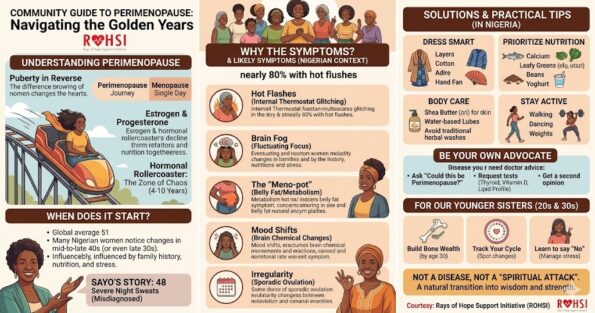
Think of perimenopause as “puberty in reverse”. Just as our young girl’s body takes years to transition into her childbearing years, a woman’s body takes time to transition out of them.
Medically, menopause is a single day—the one-year anniversary of our last period. Perimenopause, which means “around menopause”, is the entire journey that leads to that day. During this time, our ovaries, which have been diligently producing hormones for decades, begin their slow retirement. They start making less oestrogen and progesterone.
But here’s the key: the decline isn’t a smooth, gentle slope. It’s more like a hormonal rollercoaster, with levels surging and plunging unpredictably. This “zone of chaos” can last anywhere from four to ten years, and it’s the cause of the many changes our women experience.
While the global average for menopause is around 51, many Nigerian women begin to notice perimenopausal changes in their mid-to-late 40s. For some, it can start as early as their late 30s.
Think of Sayo (not her real name), a 48-year-old woman who started having night sweats so severe she had to change her clothes multiple times a night. She visited her local clinic and was given vitamins and told to “rest more”. It was only when a friend mentioned menopause that the pieces of the puzzle finally came together. Her story is the story of millions of our women.
Factors like our family history, nutrition, and even the chronic stress of our daily lives can influence when our body begins this shift. A good rule of thumb? If our mother started early, there’s a high chance one might too.
In Nigeria, research shows that nearly 80% of women experience hot flushes, and many others struggle with fatigue and joint pain. Because oestrogen affects everything from our brain to our bones, the symptoms can show up in many ways:
Likely symptoms:
Hot flashes – a sudden wave of intense heat, often followed by chills, and why? Our “internal thermostat” is glitching due to low oestrogen.
Brain Fog – Forgetfulness or feeling like you can’t concentrate, and why? Oestrogen helps the brain function; when it fluctuates, focus slips.
The “meno-pot” – weight gain specifically around the belly – and why? Our metabolism slows down, and the body stores fat differently.
Mood Shifts – Sudden irritability, anxiety, or sadness and why? Hormones directly affect our “feel-good” brain chemicals.
Irregularity – Periods that are too heavy, too light, or skip months, and why? Ovulation is becoming sporadic.
Solutions:
Dress in layers. Use breathable fabrics like cotton or Adire. Let us keep a traditional hand fan in our bag for church services or market trips.
Our local diets can be high in carbs, so let us prioritise calcium-rich foods like sardines (with the bones), leafy green vegetables (efọ and utazi), beans, and yoghurt.
For dry skin, shea butter (ori) is excellent. For vaginal dryness, use water-based lubricants—avoid “traditional” herbal washes that might cause irritation or infection.
Walking, dancing, or lightweight-bearing exercise helps keep our bones strong and our mood lifted.
Ma, if we feel something is “off”, let us be our own advocate. When visiting a doctor, let us ask specifically: “Could this be perimenopause?” We can request tests for our thyroid, vitamin D, and heart health (lipid profile). If a provider dismisses our symptoms as “just stress” without a proper check-up, we should not be afraid to seek a second opinion.
For Our Younger Sisters (20s & 30s)
You are not “too young” to prepare! Your future self will thank you if you:
- Build Bone Wealth! Most bone density is built by age 30. Eat well and exercise now.
- Track Your Cycle! Knowing what is “normal” now will help you spot “changes” later.
- Learn to say “No”: Chronic stress wreaks havoc on your hormones. Practise healthy boundaries today.
We should all remember that perimenopause is not a disease, and it is not a “spiritual attack”. It is a natural transition into a phase of strength and wisdom.