
Dear ROHSI Family, Friends, and Community Partners,
Today, September 17, 2026, we join the global community to observe World Patient Safety Day. This year, the focus hits home for nearly every household in our community: “Safe care for noncommunicable diseases (NCDs)” under the powerful slogan “Safe Care for Life!”
In our neighbourhoods, NCDs such as hypertension, diabetes, asthma, cancer, sickle cell and heart disease are no longer “distant” threats. They are the leading causes of disability and death. Because these conditions require a lifetime of management, the risk of preventable harm is significantly higher.
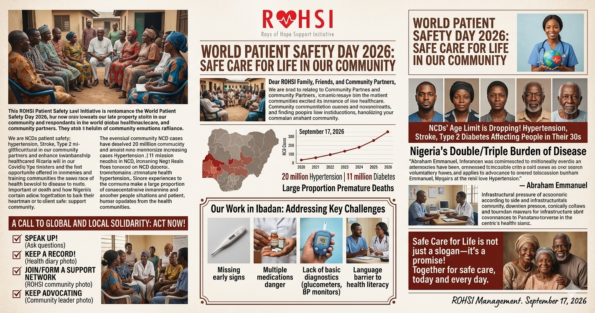
A large percentage of all deaths in Nigeria are now linked to NCDs such as cancer, diabetes, sickle cell, chronic respiratory diseases, and cardiovascular conditions, with a large proportion being premature deaths among young and middle‑aged individuals. Well over 20 million Nigerians are living with hypertension and over 11 million with diabetes, yet more than half of those affected are unaware of their status.
“Nigeria is no longer facing only communicable diseases. We are now experiencing a double burden of communicable and non‑communicable diseases, and some even describe it as a triple burden when pandemics are included.” – Abraham Emmanuel, Federal Ministry of Health and Social Welfare, Abuja.
Do we know that NCDs’ age limit is dropping? The fact that hypertension, stroke, and type 2 diabetes are now affecting people in their 30s shows that these are no longer illnesses of the elderly; they are stealing the futures of our sons and daughters.
As we know in Nigeria, our health infrastructural systems are still facing immense pressure. From fragmented care between specialists to the high cost of quality medication, the journey for patients with chronic illnesses is fraught with “safety gaps.”
Our work in Ibadan and its surrounding environments has shown that the management of NCDs often suffers from:
-
The early signs of chronic conditions often go unnoticed until complications arise.
-
The risk of taking multiple medications over many years, which can lead to dangerous drug interactions.
-
There is a shortage of functional glucometers, blood pressure monitors, and reliable medicine supplies in local clinics.
-
We must deliver health literacy and safety instructions in our native languages to ensure that every grandmother and father comprehends their treatment.
To make sure “long-term care” doesn’t mean “long-term risk,” we are focusing on four critical areas for this year’s World Patient Safety Day:
Strengthening our local health systems
That safe care requires a “primary health care-orientated” approach. We are advocating for our local Ibadan clinics to be equipped with the right tools. The goal is to ensure that patients don’t “fall through the cracks” due to a lack of basic diagnostic equipment.
Help in reducing preventable harm
From the moment of screening until long-term palliative care, every step must be safe. This includes better clinical protocols to prevent healthcare-associated infections and the unsafe use of medical devices during routine check-ups.
Meaningful patient engagement
Living with NCDs makes you the expert on your body. That is, you are not just a recipient of care; you are a vital member of the safety team. When you ask questions about your dosage or report a new symptom, you are actively preventing harm.
Addressing Determinants of Health
As we all know, safety starts wherever we live. Poor housing, lack of nutritious food, and health misinformation increase the burden of NCDs, which currently account for nearly a million preventable deaths annually worldwide. So, we are asking that steps be taken to address these issues.
This day is more than a celebration to us at ROHSI; it is a call for global and local solidarity. We must act by:
-
Ready to speak up if you live with any of the NCDs. It’s your right to ask your healthcare provider for a regular review of your treatment plan. Don’t hesitate to question a prescription if it looks different from your usual one.
-
Keeping a Record! Yes, track your blood pressure and sugar levels in a personal health diary.
-
Joining or forming a support network in your local area. Join or create small groups for those with similar conditions to share safe practices and encouragement. Kudos to our ROHSI Community people on this.
-
Keep advocating and encourage our local leaders and health authorities to prioritise patient safety in NCD programmes and ensure the availability of affordable, safe generic medicines. Yes
“Safe care for life!” is not just a slogan—it is a promise we must keep for our parents, spouses, and children. NCDs do not have to be a death sentence
Let us carry the light of possibilities into our homes and clinics. We can work together to ensure that the care meant to heal our community does not harm anyone.
Together for safe care, today and every day.
ROHSI Management.